8/18 Primary Preview
Wyoming also has primaries today, but they're all on the Republican side—every remotely winnable district in both houses of the state legislature has an uncontested Democratic primary this year, which has not always been the case in past election cycles. That leaves us with just Florida and the CA-14 special election to serve out the remainder of disgraced ex-Rep. Eric Swalwell's term. If there's one race I'm watching that's not included here, it's the Orange County Mayor primary; a crowded field including Blue Dog former U.S. Rep. Stephanie Murphy is fighting for the right to lead Orlando's Orange County, which at this point is Florida Democrats' largest remaining safe county. I just didn't have the capacity to handle it in the depth I'd like, but I will discuss the result, whatever it is, in my forthcoming recap of the August primaries.
With all that out of the way, we'll head to the Sunshine State—but first, a detour to the Bay Area suburbs, south and east of Oakland, for a congressional special election that has attracted extremely late-breaking AIPAC involvement as well as plenty of spending from other outside groups. Then, for Florida, longtime friend and reader Quinn Yeargain joins us to help me explain their home state. You can check out Quinn's other writing on state constitutions and state government here.
CA-14
Hayward, Fremont, Livermore, Pleasanton | Harris+34.8
Melissa Hernandez vs. Aisha Wahab
Total IEs: $6,598,090.36
Anti-Hernandez: $410,300
Pro-Hernandez: $2,723,929.50
Anti-Wahab: $2,900,831.25
Pro-Wahab: $563,029.61
This special election is a preview of the November general election for a full term, which will likewise be an all-Democratic top-two runoff between BART Board member Melissa Hernandez and state Sen. Aisha Wahab—except in November, whichever of the two women who wins the special will trade their current title for that of U.S. Representative, and gain the benefits of incumbency in the rematch. This was a sleepy race that seemed like Wahab’s to lose prior to the first round in June, and that first round seemingly confirmed that Wahab, who is generally seen as a progressive in Sacramento on most issues, was a strong favorite for the seat as she more than doubled up on Hernandez. However, the wider universe of centrist and establishment-aligned PACs seems to have seen a path for Hernandez after the June first round, because a whole bunch of PACs started spending to attack Wahab and boost Hernandez after that; after AIPAC’s humbling loss in the Michigan Senate race, the group seems to be treating CA-14 as a rebound, dropping $2.5 million into the race in the space of two weeks after previously expressing no interest in the deep-blue East Bay seat left open by the resignation of disgraced ex-Rep. Eric Swalwell. National progressives have hastily rallied to Wahab’s defense, joining California labor unions, which were already spending for Wahab; American Priorities, J Street, and a handful of other national PACs made late investments in this race after AIPAC made its first move into CA-14.
FL-20
Fort Lauderdale, Plantation, Wilton Manors, Tamarac, Pompano Beach | Harris+37.2
Debbie Wasserman Schultz (i) vs. Luther Campbell vs. Sheila Cherfilus-McCormick vs. Dale Holness vs. Elijah Manley
Total IEs: $421,319.07
Pro-Wasserman Schultz: $395,564.58
Pro-Manley: $25,754.49
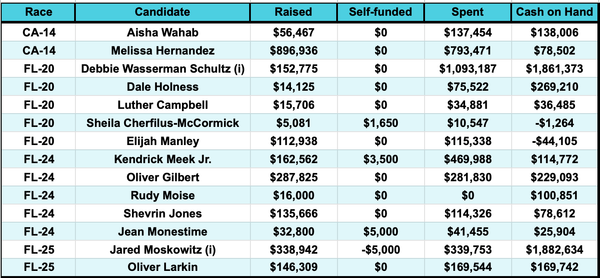
Rep. Debbie Wasserman Schultz has long been a thorn in progressives’ side; the moderate Democrat chaired the DNC during the Obama years before being forced out for perceived incompetence and favoritism to Hillary Clinton in the 2016 presidential primaries. However, she’s been a survivor in South Florida politics, beating back past primary challenges…in her old district, which got torn to shreds in Florida’s mid-decade GOP gerrymander. Rather than face a fellow Democratic incumbent in a district that made more sense—like the new, red-leaning FL-25 (which overlaps heavily with her old Broward County FL-23/25) or the new, blue-leaning FL-23 (which has no overlap with the old FL-23/25, but has a much older incumbent than Wasserman Schultz in 78-year-old Rep. Lois Frankel and no serious Frankel alternative taking up any oxygen)—she decided to take advantage of the chaos in the reshaped, Black-majority FL-20, where a field of four Black candidates gives Wasserman Schultz an opportunity to win by consolidating the white vote. Wasserman Schultz is spending like mad, dropping an easy seven figures on her attempt to switch to this district before you count the help she’s gotten from outside groups, including some tied to and indirectly funded by AIPAC. Let’s meet each opposing candidate in turn, starting with the until-very-recently incumbent.
Longtime readers may remember now-former Rep. Sheila Cherfilus-McCormick’s bizarre career trajectory: a gadfly-ish perennial candidate who ran against the late Rep. Alcee Hastings, then self-funded her way to a five-vote victory in the special primary to succeed Hastings upon his death with mysterious, previously unknown wealth. It later turned out that Cherfilus-McCormick’s mysterious wealth—the money that bought her a congressional seat—was mostly the proceeds of pandemic relief fraud, according to an indictment filed by the Trump DOJ (but clearly prepared in substantial part by the Biden DOJ due to the investigative timeline) in 2025. A subsequent investigation by the bipartisan House Ethics Committee found that Cherfilus-McCormick had committed more than two dozen ethics violations. There were even serious talks of a vote to expel Cherfilus-McCormick from Congress in advance of her trial, following the precedent set by the 2023 expulsion of Long Island Republican Rep. George Santos and the proposed 2026 expulsions of now-former Reps. Tony Gonzales (R-TX) and Eric Swalwell (D-CA), who both resigned before an expulsion vote could take place. (Before Santos’s pre-trial expulsion, which also followed a federal indictment and a finding of misconduct by the Ethics Committee, members had only been expelled for treason or following criminal convictions.) However, before the House could move to an expulsion vote—and before the Ethics Committee could separately vote on the punishment it saw fit to impose—Cherfilus-McCormick resigned, ending the House Ethics investigation and mooting the expulsion push. While Cherfilus-McCormick has name recognition from her time representing this district, not all of it is good thanks to the ethics scandals, and her fundraising has completely dried up. She’ll probably be lucky to play spoiler.
Luther Campbell, aka Uncle Luke, is a community activist and music producer best known for his part in the rap group 2 Live Crew. Campbell has previously expressed interest in South Florida politics, but this is his most serious foray into politics yet. Unfortunately for him, for a famous person—and even for a non-famous person—he is raising little and spending less.
Dale V.C. Holness is the former Broward County Commissioner who lost that special primary election to Sheila Cherfilus-McCormick in 2021. He badly lost a rematch with Cherfilus-McCormick in 2022, 66-29, but has a definite base of support, particularly in the area’s large Jamaican community. (Holness is a Jamaican immigrant.) He is not spending much according to the FEC, probably because most of his campaign’s cash balance is from loans of his own personal funds. And Holness has a ton of personal baggage: both of his daughters have felony convictions for separate COVID relief fraud schemes, as well as allegedly embezzling from Holness’s past campaigns.
27-year-old activist Elijah Manley is a bit of an odd case. While he could fairly be described as a perennial candidate, he’s also the clear progressive choice and has managed to demonstrate greater fundraising ability than he had ever done in his prior campaigns for state and local office. His campaign is broke, but that’s because the campaign has spent more than it’s raised—just over a million dollars at this point. He started out as a primary challenger to Cherfilus-McCormick, and stayed in the race after her resignation and the Republican gerrymander upended everything. Manley has won over most progressive groups, as well as a handful of local elected officials, and what little polling we have (a Manley internal from June) says he actually might have the best chance at stopping Wasserman Schultz. (It’s either him or Holness, the only two non-DWS candidates to pull double digits in the poll.) That Manley poll also says that anyone but Cherfilus-McCormick beats Wasserman Schultz in a head-to-head, suggesting undecided voters may break heavily against Wasserman Schultz and in favor of her Black opponents—the main question is whether any one opponent can consolidate enough of the Black vote to beat Wasserman Schultz. If any candidate has juice with white voters other than Wasserman Schultz, it’s likely Manley, who is gay and is openly targeting Broward County’s gayborhoods like Wilton Manors and Oakland Park, where the bulk of his elected endorsements come from.
FL-24
Miami, North Miami, Miami Gardens, Miramar, Hollywood | Harris+38.7
Marshall Davis vs. Oliver Gilbert vs. Shevrin Jones vs. Kendrick Meek Jr. vs. Rudy Moise vs. Jean Monestime vs. Roderick Vereen
Total IEs: $5,770,063.27
Anti-Gilbert: $2,308,883.81
Pro-Gilbert: $856,658.14
Anti-Jones: $389,086.56
Pro-Jones: $2,132,101.42
Pro-Meek: $83,333.34
This messy and expensive primary has managed to evade notice even more thoroughly than FL-20, perhaps because the dividing lines aren’t very clear. State Sen. Shevrin Jones is a middle-of-the-road Democrat whose backing from the cryptocurrency industry and PACs aligned with House Democratic leadership strongly imply he’s no progressive; Miami-Dade County Commissioner Oliver Gilbert III is a Republican-friendly machine creature who is clearly worse than Jones, but not that ideologically distinct; and Kendrick Meek Jr., an attorney and liberal activist who is the son and grandson of this district’s former representatives (Kendrick Meek Sr. and his mother Carrie Meek), is sort of hoping to run up the middle as Gilbert and Jones’s allied PACs bludgeon the two frontrunners on the air, on the web, and in voters’ mailboxes. Miami-Dade County Commissioner Jean Monestime and self-funding Dr. Rudy Moise add a touch more unpredictability to the race, but both lag far behind the top three in fundraising. I wish I had more to say, but this race has me completely flummoxed.
FL-25
Miami Beach, Fort Lauderdale, Deerfield Beach, Boca Raton | Trump+9.1
Jared Moskowitz (i) vs. Oliver Larkin
Total IEs: $623,556.70
Pro-Moskowitz: $559,573.55
Pro-Larkin: $63,983.15
Rep. Jared Moskowitz is hands-down one of the worst Democrats in the House. A former state representative for coastal Broward County, Moskowitz took an appointment as director of the Florida Division of Emergency Management in 2019 from Gov. Ron DeSantis, where he managed the first year and change of Florida’s COVID response; he was later appointed by DeSantis to fill a vacancy on the Broward County Commission in 2022, before he announced his congressional campaign that same year. Moskowitz won that 2022 race after nobody particularly credible or progressive stepped up to challenge DeSantis’s favorite Democrat, and won another term in 2024 as his district lurched right and nearly voted for Donald Trump. Then Florida Republicans passed a mid-decade gerrymander that chopped up Moskowitz’s FL-23 and turned it into a bizarre, red-leaning Frankendistrict that combines coastal Miami-Dade, Broward, and Palm Beach counties with the parts of inland Fort Lauderdale that don’t fit in the remade FL-20. To his very minimal credit, Moskowitz stuck to the 25th rather than trying to elbow Black Democrats out of the way in FL-20 or FL-24. The problem for Moskowitz is that so did his primary challenger, democratic socialist union organizer Oliver Larkin.
Larkin is, in many ways, a terrible fit for this seat. The reformed FL-25 is an upper-middle-class, retiree-heavy district where primaries are likely to be dominated by older voters. Larkin has focused heavily on Gaza and Israel, and this district has a large population of older, pro-Israel Jewish voters; Larkin has focused on economic populism, and this district is largely populated by comfortable older people. However, Moskowitz is an obnoxiously conservative Democrat who seemingly doesn’t play well with others, if the bevy of endorsements from unions and Democratic clubs for Larkin’s longshot campaign is any indication. Larkin will likely lose, and would probably be a much riskier bet in a general election than Moskowitz, who is frankly a better fit for this district than he ever was for his old, blue district; however, Larkin’s performance will serve as a barometer for the left’s strength in South Florida as well as a measure of voter dissatisfaction with performatively conservative Democrats.
SD-16
Tampa to St. Petersburg | Harris+25.7
Fentrice Driskell vs. Michele Rayner
State Senator Darryl Rouson, a moderate who has more than occasionally sided with Republicans, is term-limited. Rouson only narrowly won a 2016 primary against two more reliably liberal Democrats, but has easily held this seat since then. Though he considered running for the State House this year, he’s thankfully not doing that. Two state representatives—Fentrice Driskell and Michele Rayner—are running to succeed him in this Black-majority district, which hops across Tampa Bay to include Black neighborhoods in Tampa and St. Petersburg. Because they’re the only two candidates to file, the primary isn’t closed, and all voters in the district will be able to vote in the primary, not just Democrats.
Driskell is the current Minority Leader of the State House. She was first elected to the State House in 2018 from a swing district, and post-2020 redistricting gave her a safer seat. Rayner is the first openly queer Black woman to serve in the state legislature. Driskell is the favorite in the race. She’s outraised Rayner by a decent amount and has won a bunch of endorsements from groups across the ideological spectrum—from the police union to the AFL-CIO and the Sierra Club. She’s also likely benefited as the more moderate candidate (though only slightly) in the open primary, and by geography, because most votes in the primary will be cast in Hillsborough County (Tampa), not Pinellas County (St. Petersburg), where Rayner is from. Rayner has won support from some notable progressives, like state Sen. Carlos Smith, and has raised enough money to be competitive, though Driskell's various committees have about twice as much money to work with as Rayner's. Both Driskell and Rayner would be steps up from Rouson, but Rayner would be the more progressive option.
Fundraising (as of July 31 filings):
SD-34
Miami, North Miami, Opa-locka, Miami Gardens | Harris+38.9
Ashley Gantt vs. Shannan Ighodaro vs. Christine Sanon-Jules Olivo
State Sen. Shevrin Jones is running for Congress rather than seek re-election, which has created one of several open seats in the Miami area. Three candidates are running to replace him: state Rep. Ashley Gantt, former Miami Gardens City Councilwoman Shannan Ighodaro, and physician Christine Sanon-Jules Olivo. Gantt was first elected to the State House in 2022, when she narrowly ousted James Bush—more on him below—in the Democratic primary. She’s the likely frontrunner in this race, having consolidated support from unions and state and local Democrats and outraised her opponents. She’s also the best choice in the district. Ighodaro is data center-curious, and Olivo is endorsed by former state Sen. Daphne Campbell (more on her below), a notoriously corrupt and socially conservative Democrat. A sizable Gantt victory seems like the likeliest outcome here, but not much money is flowing into this race, and both Ighodaro and Olivo have potentially credible bases of support.
HD-13
Northwest Jacksonville | Harris+23.8
Aubrey Gibson vs. Leslie Jean-Bart
State Rep. Angie Nixon is retiring to run for the U.S. Senate. On the one hand, it’s great that Florida Democrats will have an option other than Alex Vindman, but on the other hand, she’s been a solid progressive in the state House. She was elected in 2020, when she managed to defeat conservative Democrat Kim Daniels (regrettably, more on her below) in the Democratic primary, and has been a vocal progressive since then. Two candidates are running to replace her: former state Sen. Aubrey Gibson and attorney Leslie Jean-Bart. Gibson should be the frontrunner in this race—she served in the legislature for two decades before getting termed out and has support from big institutional groups. But she flamed out in a forgettable mayoral campaign in 2023, and Jean-Bart has kept financial parity with her. There are lots of internecine conflicts within Jacksonville Democrats—some of which fall on personal lines, others on ideological ones—but Gibson seems to have more support from local business groups, the police union, and folks like corrupt former Congresswoman Corrine Brown and conservative state Rep. Kim Daniels. Jean-Bart is supported by some big local progressive groups and mainstream Democrats like state Sen. Tracie Davis, and won the endorsement of the Florida Times-Union, which could help move undecided voters. The ideological stakes here aren’t as big in some other races, but Jean-Bart would be the more progressive choice. It’s disappointing that Gibson has thrown her lot in with Kim Daniels.
HD-14
North Jacksonville | Harris+25.6
Kim Daniels (i) vs. Khian Tutson
Unfortunately, state Rep. Kim Daniels is favored to win renomination over former highway patrol trooper Khian Tutson. This newsletter has written about Daniels in 2020, 2022, and 2024 before, so to quote from our 2020 summary:
She’s absolutely, and comically, terrible for reasons that are difficult to fit into this newsletter. Let’s try. For a start, all of these are actual Kim Daniels quotes:
“You can talk about the Holocaust, but the Jews, they own everything!”
“I thank God for slavery […]if it wasn’t for slavery, I might be somewhere in Africa, worshipping a tree.”
“We curse gay pride to the root and declare that i[t] is nothing to be proud of; it is an abomination in the eyes of the Lord […]We come against the witchcraft that is working behind the scenes of the homosexual agenda.”
It won’t surprise you that Daniels is aggressively anti-abortion, introduced legislation to mandate Bible studies in public schools, and, while she was on the Jacksonville City Council, opposed an anti-LGBT discrimination ordinance, drawing a bizarre analogy to Biblical Egypt, which she said also had anti-LGBT discrimination laws, along with laws allowing bestiality and necrophilia.
Tutson, meanwhile, is an entirely normal candidate. She’s been endorsed by some of the more progressive folks in Jacksonville Democratic politics, like Angie Nixon and Tracie Davis, but has unfortunately not been able to match Daniels’s fundraising. Tutson is also hurt by the fact that she and Daniels are the only candidates running, so all voters can vote. Daniels can count on support from Republicans—she’s cashing their checks and taking their endorsements as it is—so Tutson has a tough path forward. Still, the fact that Davis has endorsed her might say something meaningful. Expect, unfortunately, a Daniels win.
HD-21
Gainesville to Ocala | Harris+21.4
Sylvain Doré vs. Antione Fields vs. Xavier Monroe vs. Malik Moore vs. Jackie Randall
This district links together Black neighborhoods in Alachua County (Gainesville) and Marion County (Ocala), and has been represented by state Rep. Yvonne Hayes Hinson since 2020. Hinson isn’t seeking re-election this year, and there’s a crowded field to succeed her: former UF neuroscience professor Sylvain Doré, organizer and former legislative aide Antione Fields, NSF official Xavier Monroe, legislative staffer Malik Moore, and former Hawthorne Mayor Jackie Randall. Fields is the best option here; he’s endorsed by the Alachua County DSA, Gainesville Sunrise Movement, and several local progressives. The other candidates are campaigning as fairly standard-fare Democrats, and none seems like they’d lurch the seat to the right. This is also a tough race to handicap, because they each seem to have won enough local endorsements to be credible and they’ve all raised about the same amount of money. The split field might allow Doré, the only white candidate in the race, to win a slim plurality. But regardless, the winning candidate will be lucky to win 30 percent of the vote.
HD-43
Eastern Orlando | Harris+10.7
Daisy Morales vs. Samuel Vilchez Santiago
State Rep. Johanna López, a member of the informal progressive bloc in the State House, is running for Orange County Commission. Two candidates are running to succeed her: organizer Samuel Vilchez Santiago, the former chair of the county party, and former state Rep. Daisy Morales. Santiago is both the clear favorite and the obvious choice here: he came to the United States from Venezuela after getting asylum, and has been a big part of the progressive movement in Orlando. He’s raised a bonkers amount of money and has racked up an impressive list of local endorsements. Morales, on the other hand, is a legit oddball. This newsletter wrote about her in 2022 and 2024, and while Morales had some ideological deviations during her single term, the most notable thing about her is that she’s just universally recognized as a weirdo. Expect Santiago to coast.
HD-46
Kissimmee | Harris+12.2
Jose Alvarez (i) vs. Robert LeWayne Johnson
State Rep. Jose Alvarez is running for a second term in this majority-Hispanic district that lurched to the right in 2024. He’s an uncontroversial enough incumbent, and faces a challenge from homelessness activist and veteran Robert LeWayne Johnson. Alvarez seems uncontroversial, and Johnson has raised hardly anything—but Johnson was endorsed by the state party’s environmental caucus, which is more just curious than anything else. Alvarez will likely coast to victory in the primary.
HD-47
St. Cloud and Buenaventura Lakes | Trump+2.8
Jorge Figueroa vs. Anthony Nieves
This is an amusing one: Republican state Rep. Paula Stark was running for re-election, fucked up her paperwork, and got disqualified from the ballot. She tried to get back on the ballot, but the lawsuit she filed was dismissed, and she seems to have given up. That left only two Democrats—businessman Jorge Figueroa and former fraud investigator Anthony Nieves—on the ballot in what was going to be a close race this November in a Hispanic-majority Clinton-Biden-Trump district. Instead, it’s an automatic Democratic flip. Figueroa is a little vague about his commitments, and is endorsed by Associated Industries of Florida, one of the state’s biggest corporate groups. Nieves, on the other hand, is campaigning in support of abortion rights, renters’ rights, and blocking the construction of data centers, and has the support of local progressives and progressive groups. Figueroa has outspent Nieves, but because of some self-funding from Nieves, they’ve kept financial parity. It’s hard to handicap this race, and the open primary dynamic in a relatively low-salience race in a swing district makes it harder to predict.
HD-62
St. Petersburg to Tampa | Harris+34
Kyandra Darling vs. Wengay “Newt” Newton
State Rep. Michele Rayner is running for the State Senate (discussed above), and there’s an open race to succeed her. Legislative aide Kyandra Darling is running, with the endorsement of Rayner, Bernie Sanders, and many local Democrats, and she faces former atate Rep. Wengay “Newt” Newton in the primary. Newton is a conservative Democrat. As this newsletter covered in 2022, Newton has endorsed Republicans over Democrats in the past (and gladly claimed their endorsements, too), was criticized by the Sierra Club for having a terrible environmental record, and sided with Republicans on charter schools in the legislature. Fortunately, he’s likely the underdog in this race. Not only does Darling have a solid set of national and local support, she’s outraised Newton significantly. Newton was in elected office for a while, so definitely comes into this race with some name recognition, but Darling is likely the favorite.
HD-63
Central Tampa | Harris+41.1 (open primary)
Jacqueline Coffie-Leeks vs. Robin Lockett vs. Conrad Schupay
The bluest seat in the Tampa Bay region is open due to term limits, and three candidates, all Democrats, have filed for it. Fundraising leader Jacqueline Coffie-Leeks is backed by the Florida Chamber of Commerce and the Associated Industries of Florida, signaling a centrist, business-friendly Democrat at best. (Unfortunately, Coffie-Leeks also has the Florida AFL-CIO in her corner.) The better choice is Florida Rising regional organizer Robin Lockett, who leads the progressive organization’s operations in the Tampa Bay area and has the endorsement of outgoing incumbent Dianne Hart. Rounding out the field is Conrad Schupay, a white Army veteran who will likely struggle in this seat, which has a large Black plurality; however, he’s not broke, and has managed to win over the Florida Medical Association and a firefighters’ union local, so it’s not inconceivable (though it is unlikely) to see Lockett and Coffie-Leeks splitting the remaining vote close to evenly.
Both Coffie-Leeks and Lockett have run for office once before: Coffie-Leeks for school board in 2016 and Lockett for Tampa City Council in 2023, both unsuccessful. However, Lockett seems to have made a good impression in her city council run—such a good impression, in fact, that the city councilman she ran against, Guido Maniscalco, is among her endorsers in her run for state House.
HD-64
Northwest Tampa, Town ‘n’ Country | Trump+2.7
John Rodriguez vs. Luis Salazar vs. Mike Suarez
This district lurched hard to the right in 2024—so hard to the right that state Rep. Susan Valdés, who won all her elections as a Democrat, saw fit to switch parties for her final term representing it. (Valdés is term-limited this year.) Three Democrats are vying for the chance to reclaim the seat. The fundraising leader is former Tampa City Councilor Mike Suarez, who is backed by a number of prominent Tampa-area Democrats (including Darryl Rouson) and the Associated Industries of Florida; he’s clearly the moderate choice here. On the left is Navy veteran and Democratic activist Luis Salazar, the former president of the Hillsborough County Democratic Party’s LGBTQ+ Caucus. Salazar also counts a number of prominent area Democrats among his endorsers, as well as members of the state legislature’s progressive bloc. His biggest vulnerability is one he’s had no choice but to address head-on: a string of DUIs across multiple states from more than a decade ago, before Salazar says he got clean and dedicated himself to community service. Organized labor, up to and including the Florida AFL-CIO, largely prefers Salazar in this race anyway. (Unfortunately, so do Florida Republicans.) The third candidate is John Rodriguez, who has by far the least money of anyone in the field but some prominent endorsements including former St. Petersburg Mayor Rick Kriseman, for whom Rodriguez worked as an aide after more than a decade as a Democratic aide in the state legislature.
HD-98
Oakland Park, Pompano Beach, Deerfield Beach | Harris+29.7
Mitch Rosenwald (i) vs. Keith Abel
Democratic activist Keith Abel placed a somewhat distant third in the crowded, incumbent-free open primary won by then-Oakland Park Mayor Mitch Rosenwald in 2024, and is back for a one-on-one matchup with the now-incumbent. Abel has managed to win over a couple of Democratic clubs and Emgage Action, but the AI aesthetic of all his campaign materials is really distracting. However, Abel, like a plurality of this district’s residents, is Black while Rosenwald is white, and it’s not unforeseeable that Abel could ride that to a stronger-than-expected showing. (On the other hand, Rosenwald is gay and the former mayor of Oakland Park; HD-98 contains a good chunk of Broward County’s gayborhoods, primarily in Oakland Park.)
HD-108
Little Haiti, North Miami | Harris+46.7
Daphne Campbell vs. Dinah Escarment vs. Peter Walsh
With state Rep. Dotie Joseph running for governor, Miami’s Little Haiti will be getting a new state representative. The worst-case scenario here is that the new state representative might also be the old state representative: Daphne Campbell, who represented a version of this seat from 2010 to 2016 and also briefly served in the state Senate before losing a primary. Campbell is a…colorful character; whether it’s ethical challenges, residency questions, or calling the cops on reporters, you’re never bored with Daphne Campbell. (Unfortunately, while you're never bored with Daphne Campbell, you’re always cringing in secondhand embarrassment.) The best chance at stopping her is state party committeewoman Dinah Escarment, a former teacher and community activist backed by progressive groups and local papers. Escarment has raised more than Campbell and has Joseph’s endorsement, but Campbell is spending handsome sums of her own money to return to Tallahassee. Also in the race is Miami Shores attorney Peter Walsh, who seems destined to place third while winning a lot of votes from this seat’s white minority.
HD-109
Opa-locka to Liberty City | Harris+30.2 (open primary)
James Bush III vs. Satin Fye vs. Cuthbert “Broadway” Harewood vs. John Taylor
With incumbent Ashley Gantt going for state Senate, this district’s former representative is looking for a comeback. James Bush III was a conservative Democrat who regularly crossed the aisle to vote with Republicans, particularly on social issues like Gov. Ron DeSantis’s infamous Don’t Say Gay law and the state’s abortion ban, until Gantt unseated him in the 2022 primary. Stopping him is urgently important. Gantt is backing Opa-locka Mayor John Taylor, who is clearly Bush’s main opponent; Taylor is both the only other candidate with elected experience and the only candidate with more money to work with than Bush. Flight attendant and union activist Satin Fye is running a low-budget campaign vaguely to the left, and self-funding Liberty City community leader Cuthbert “Broadway” Harewood rounds out the field with a focus on public education and community development.