Q2 2026 FEC roundup
Highlights & Housekeeping
First, a reminder that the paywall will be going up on the entire site starting on August 9, so subscribe now. This FEC roundup would ordinarily be available at the second and third tiers of subscription, but everyone gets it until the paywall drops.
Second, welcome back, for real. I've missed this, and I'm ready to dive right back in with analysis of the second quarter's FEC filings in Democratic primaries across the country.
On the House front, three incumbents were outraised: Doris Matsui (CA-07), by Justice Democrats-backed Sacramento City Councilor Mai Vang; John Larson (CT-01), by former Hartford Mayor Luke Bronin; and Ed Case (HI-01), by state Sen. Jarrett Keohokalole. A fourth, Shri Thanedar (MI-13), was outraised by Justice Democrats-backed state Rep. Donavan McKinney if you don’t count Thanedar’s self-funding (I count that separately for a reason) but do count the losses his campaign’s reported crypto portfolio took, which wiped out his fundraising and then some. One incumbent—Larson—now trails in cash on hand, too, painting a dire picture for Hartford’s longtime congressman as he stares down Bronin. And while top Ways & Means Democrat Richard Neal still has a wide fundraising lead, challenger Jeromie Whalen, a high school history teacher and pro-Palestinian activist, posted his first six-figure quarter—apparently without tapping the world of mostly Muslim pro-Palestinian donors who have stepped up to fund many left campaigns this cycle, based on a look through his itemized donations. Finally on the House front, I have little confidence in the accuracy of Byron Nolen’s numbers in MI-12—his FEC form was riddled with errors, and this is my best attempt at translating it into something legible. (Not that it matters much, as his challenge to Rashida Tlaib is doomed.)
On the Senate front, Abdul El-Sayed’s fundraising continues to be so exceptionally strong that he is able to comfortably outspend Haley Stevens’s campaign, leaving the Oakland County congresswoman to rely on AIPAC and other PACs to give her the financial advantage in this race. (To be clear, Stevens has the financial advantage, despite El-Sayed’s fundraising strength, due to the PAC spending, which is truly staggering in its scale.)
Before I dive into the chart and the race-by-race summaries, now is a good time to introduce a new change to the newsletter’s coverage criteria: Dem-held Trump seats are now fair game generally (previously, we made race-by-race exceptions but generally avoided them), and GOP-held seats can be covered if a major Democratic establishment group (e.g. the DCCC, DSCC, House Majority PAC) is involved in the primary, either by endorsing and supporting a candidate they like or by spending to stop a candidate they don’t want. The expanded criteria are meant to capture all races with meaningful implications for the direction of the Democratic Party—because sometimes those fights play out in swing seats. Additionally, on a more granular level, candidates who do not raise, spend, or have on hand at least $5,000 in a quarter will be excluded from the FEC chart unless they are a current or former elected official or another compelling reason exists for their inclusion.
The Big Chart
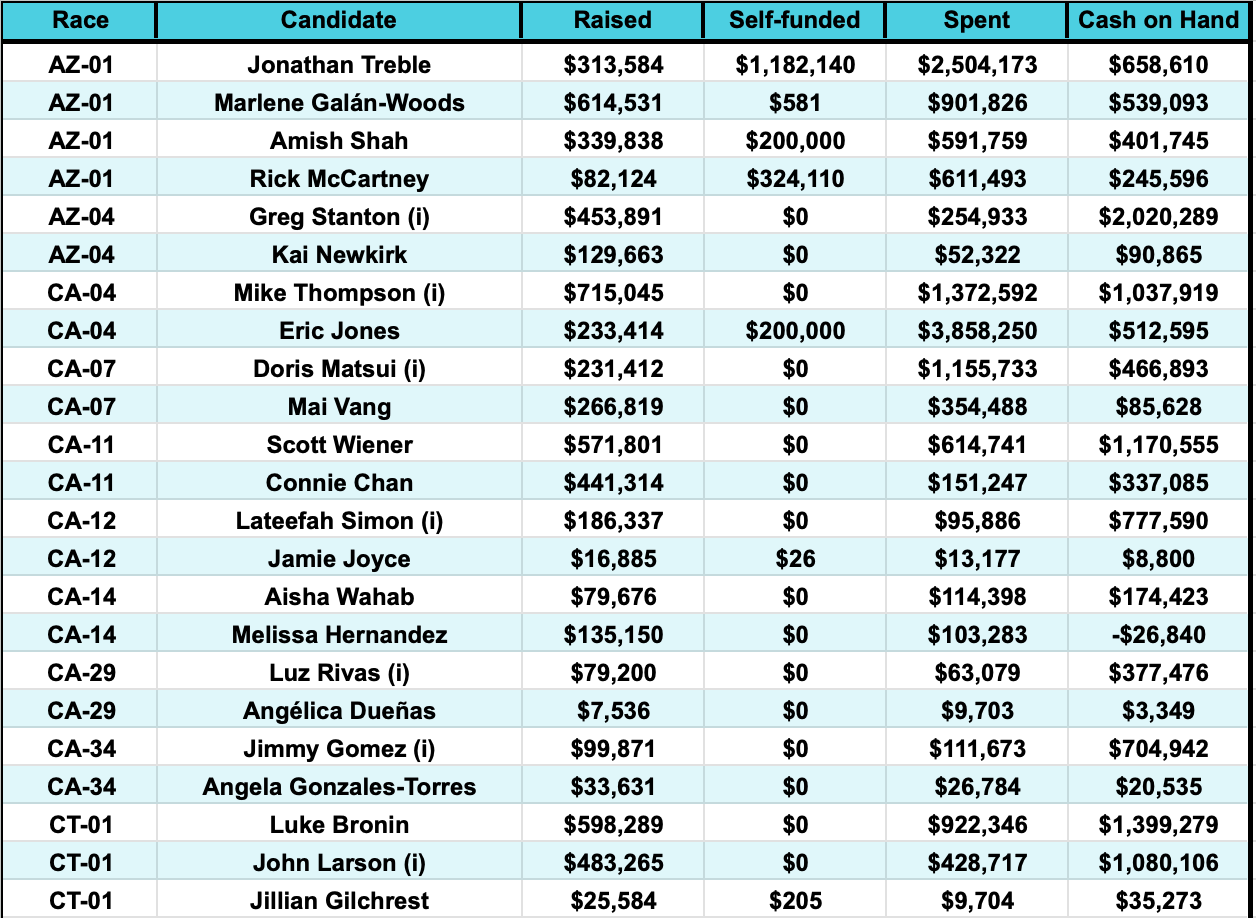
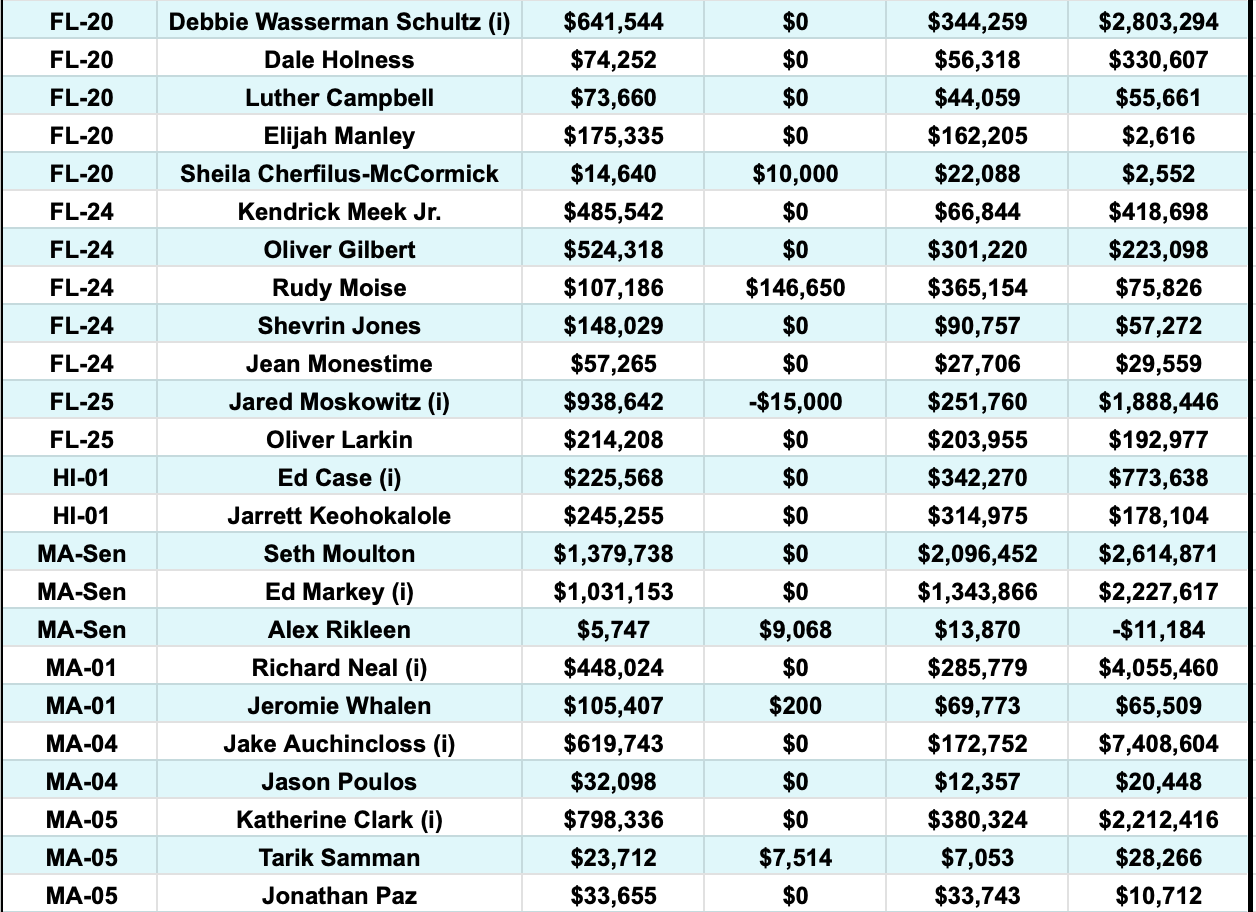
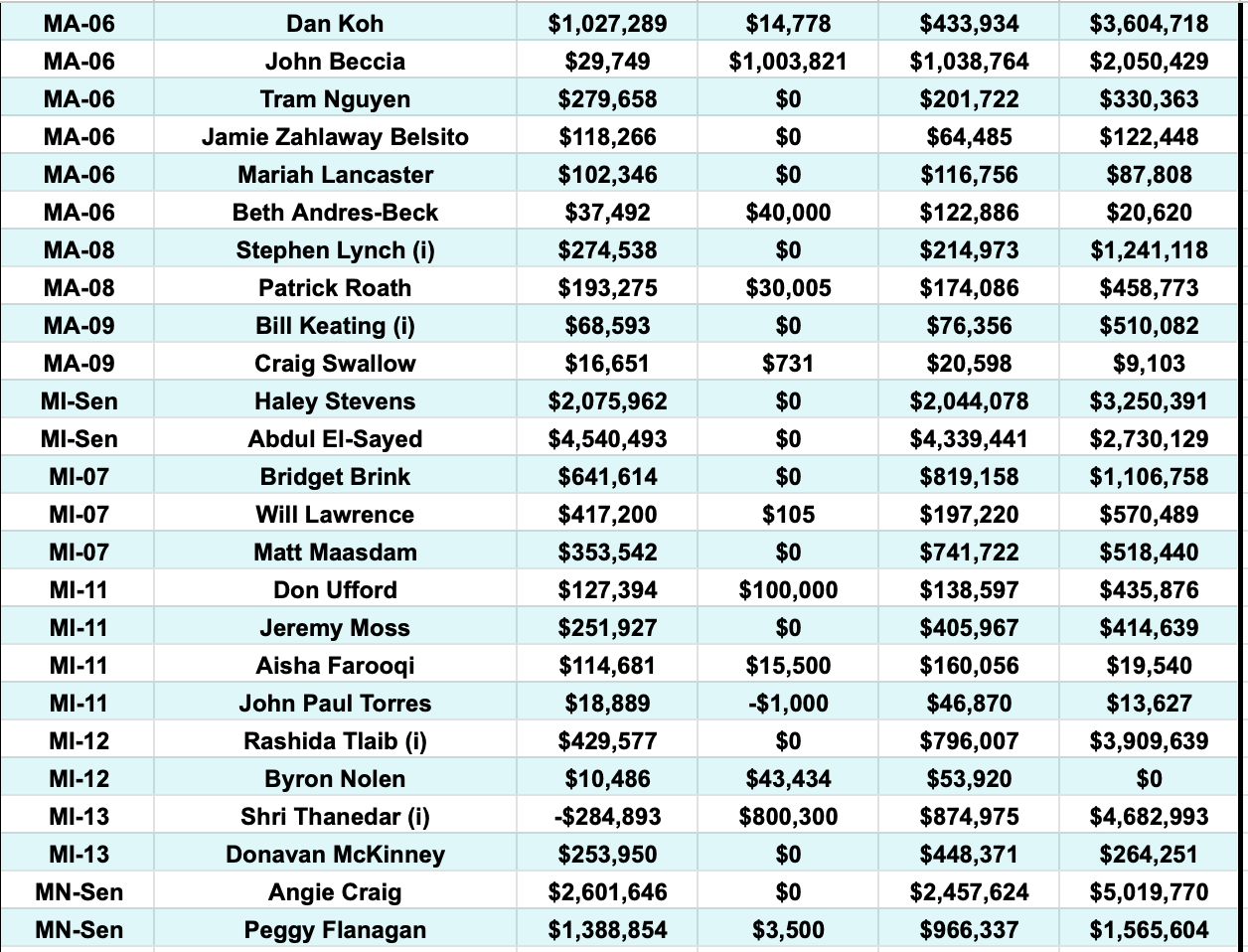
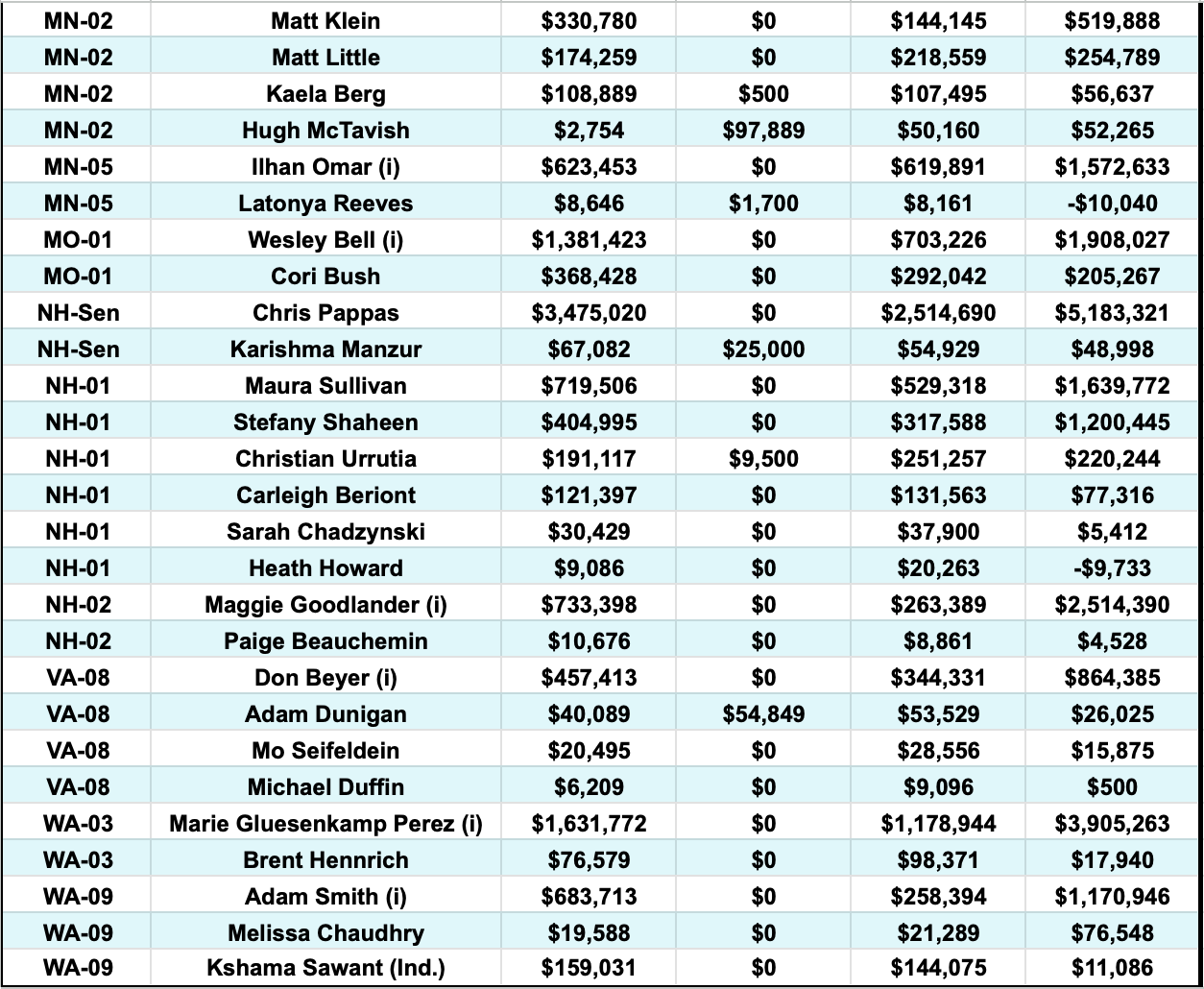
The Details
AZ-01: 2024 nominee Amish Shah is spending heavily in an attempt to get back on the November ballot, but DCCC pick Marlene Galán-Woods and self-funding progressive Jonathan Treble are both outspending him by a considerable margin for the right to carry the Democratic banner in Republican Rep. David Schweikert’s open Phoenix-area swing seat.
AZ-04: Rep. Greg Stanton is taking his challenge from democratic socialist Kai Newkirk seriously in this Phoenix-Tempe-Mesa district; Newkirk, for his part, saved most of his money for the end, presumably for a last-minute ad-and/or-mail blitz, which is a smart move.
CA-04: Mike Thompson and self-funding progressive challenger Eric Jones both raised—and spent—a lot in the final weeks of the primary, which resulted in Jones, aided by a hefty spending advantage, narrowly boxing Republicans out of the general election in this district which stretches from Sacramento to California’s wine country north of San Francisco Bay.
CA-07: In addition to being outraised, Doris Matsui spent down most of her cash reserves in her ultimately unsuccessful attempt at keeping Mai Vang out of the general election. Vang is even more broke than Matsui, but she’s now raising faster than the congresswoman; to be fair, that’s a dynamic which could easily change if Matsui calls in more national help.
CA-11: State Sen. Scott Wiener has a financial advantage over questionable progressive Connie Chan, a member of the San Francisco Board of Supervisors backed by outgoing Rep. and former Speaker Nancy Pelosi, but Chan is hardly struggling to raise money herself.
CA-12: This Oakland/Berkeley district is so blue that hopeless protest candidate Jamie Joyce managed to get to the general election against progressive Rep. Lateefah Simon, but that’s all that’s going on here.
CA-14: State Sen. Aisha Wahab probably doesn’t need to worry about her finances against BART Board President Melissa Hernandez, considering how far Hernandez finished behind Wahab in the June primary ahead of the August 18 special election runoff (43%-17% in the special primary and 38%-17% in the concurrent regular primary for the full term.) The special is being held to fill the vacancy left by Eric Swalwell’s resignation.
CA-29: Leftist perennial candidate Angélica Dueñas remains broke, but she keeps locking Republicans out of general elections, so hey, why not?
CA-34: Unlike most other California districts, where Republicans at least have a chance at advancing to November, the real contest in deep-blue CA-34 was always going to be a Dem-on-Dem November election, which is why Rep. Jimmy Gomez didn’t really bother to try to keep Justice Democrats-backed activist Angela Gonzales-Torres out of the general election. (It would have been a waste of money; she finished more than fifteen points ahead of the lone Republican on the ballot, taking 30.7% to Gomez’s 46% and the Republican’s 13.7%.)
CT-01: As mentioned above, things look dire for longtime Rep. John Larson. Former Hartford Mayor Luke Bronin, a well-connected middle-of-the-road Democrat, is outraising and outspending the ideologically similar incumbent by a wide margin, with progressive state Rep. Jillian Gilchrest taking a distant third in fundraising just as she is likely to do in votes cast.
FL-20: Rep. Debbie Wasserman Schultz is raising well, but that’s to be expected for a centrist incumbent; what says more is the fact that her field of opposition is badly split between four opponents who are all raising credible but low amounts as Wasserman Schultz attempts to carpetbag to a majority-Black district. Leftist Elijah Manley is the strongest alternative by fundraising strength, but former Broward County Commissioner Dale Holness is the strongest alternative by cash on hand.
FL-24: The open seat of retiring Rep. Frederica Wilson, a Black-majority seat in the Miami area, at first seemed like it might go to Shevrin Jones, an uncontroversial state senator. However, Jones is getting outraised and outspent by Miami-Dade County Commissioner Oliver Gilbert III, as well as by Kendrick Meek Jr., the son of former Rep. Kendrick Meek; veteran Dr. Rudy Moise is also in the same ballpark as Jones.
FL-25: Rep. Jared Moskowitz is finally getting the district he deserves: a Trump+9 district in coastal South Florida, befitting of one of House Democrats’ worst members (and the only one to have held a Cabinet position in the administration of Ron DeSantis.) However, democratic socialist and union organizer Oliver Larkin is following Moskowitz to the 25th—bringing his reasonably-well-funded campaign with him and forcing Moskowitz to prove his Democratic bona fides before he can advance to face a Republican in this reddish district.
MA-Sen: Sen. Ed Markey is getting outraised and outspent by centrist transphobic Rep. Seth Moulton as he fights to keep a seat he probably should have relinquished this cycle (to someone other than Moulton.) Yikes.
MA-01: Richard Neal is spending like he’s aware he has a primary, but not like he’s particularly scared of it; like with many of his colleagues, I wonder whether the upset losses of Reps. Adriano Espaillat and Diana DeGette, and the surge in Jeromie Whalen’s fundraising, will spur Neal to panic a little more in the final FEC reporting period, which will wrap up in mid-August.
MA-04: Honestly, that’s more money than I thought AI researcher Jason Poulos would raise in his challenge to hyper-centrist Rep. Jake Auchincloss, who has never been liked by Massachusetts progressives ever since he won a tight and acrimonious 2020 primary thanks to progressives splitting the vote about as hard as humanly possible.
MA-05: Neither of Katherine Clark’s challengers is raising what you’d need to put a real scare into the second-ranking House Democrat, but I have a hunch that her Boston-area district—packed to the brim with college towns and college grads—may be primed for a good showing for a protest vote anyway.
MA-06: Centrist Dan Koh is way out in front in the money race, with self-funder John Beccia and mainline liberal state Rep. Tram Nguyen rounding out the top three as progressives Mariah Lancaster and Jamie Zahlaway Belsito and democratic socialist Beth Andres-Beck struggle to break through. All six candidates are raising enough that they should be able to register some meaningful support with the primary electorate, which is a recipe for a winner with a very low plurality.
MA-08: Considering his current capacity for spending, and the ample funds available to any incumbent with a primary challenge, long-tenured Rep. Stephen Lynch is not raising or spending like he’s scared of well-funded challenger Patrick Roath, a lawyer backed by his former boss, former Massachusetts Gov. Deval Patrick, as well as some labor unions and progressive local elected officials. Either Lynch knows something everybody else doesn’t, or he’s sleepwalking into the toughest primary of his career.
MA-09: New Bedford Indivisible activist Craig Swallow isn’t raising much in his bid to represent Cape Cod and Massachusetts’s South Coast, but neither is Rep. Bill Keating, one of the most forgettable Democrats in the House.
MI-Sen: El-Sayed’s fundraising is fueled by incredible strength with small-dollar donors as well as large donors—more than $1 million of El-Sayed’s haul was unitemized, meaning it came from donors who have given less than $200 cumulatively. (Only $226,000 of Stevens’s haul came from unitemized donations.)
MI-07: Former Ambassador to Ukraine Bridget Brink has the money to keep outspending her opponents for the right to face Republican Rep. Tom Barrett in this Lansing-area seat, including progressive Will Lawrence, who allies of the DCCC are intervening to stop, as well as centrist Matt Maasdam, who is endorsed by Sen. Elissa Slotkin.
MI-11: Progressives Aisha Farooqi and John Paul Torres lag centrist establishment favorite and DMFI endorsee Jeremy Moss, a state senator, as well as former Ford engineer Don Ufford, who is running as a mainline liberal.
MI-12: As you might have picked up above, Rashida Tlaib will be fine.
MI-13: Thanedar may be losing bonkers money on his crypto portfolio, but his campaign still has the resources to outspend Donavan McKinney two to one—and there’s no reason to believe Thanedar’s seemingly endless capacity for self-funding has changed. But McKinney was always going to be outspent; he has the resources to run a real campaign (aided by a mountain of local endorsements and Detroit DSA’s ground game) and seems to be running one.
MN-Sen: Rep. Angie Craig will need every dollar to overcome her pro-ICE voting record, and unfortunately she seems to have every dollar. Thankfully, progressive Lt. Gov. Peggy Flanagan has the Minnesota DFL endorsement thanks to near-unanimous support from party activists, and the in-state DFL establishment also favors Flanagan for the most part. Craig is mostly reliant on national connections, national endorsements, and national money.
MN-02: Centrist state Sen. Matt Klein is lapping his more progressive opponents, state Rep. Kaela Berg and DFL-endorsed former state Sen. Matt Little, potentially imperiling progressives’ hopes of getting an upgrade in Angie Craig’s House seat.
MN-05: Ilhan Omar’s token challenger, DNC member Latonya Reeves, is flat broke, reflecting the fact that she has gained little to no traction even with Omar’s usual detractors in her Minneapolis seat. She should lose by the widest margin of any Omar challenger to date.
MO-01: Rep. Wesley Bell is wildly outraising and outspending democratic socialist former Rep. Cori Bush as she seeks to reclaim her seat, but Bush is raising enough to run a serious and comprehensive campaign with a full suite of advertising and mail. Most of Bell’s money—just over a million dollars this quarter—was bundled by AIPAC.
NH-Sen: Centrist Rep. Chris Pappas looks likely to get a promotion to the Senate without much of a fight, which is a shame, because Pappas never saw a Republican culture war resolution he wouldn’t vote for.
NH-01: While centrists Maura Sullivan and Stefany Shaheen battle it out with the most money, progressives Christian Urrutia and Carleigh Beriont are thankfully far from broke. Democratic socialist state Rep. Heath Howard, however, is not.
NH-02: Centrist Rep. Maggie Goodlander is set to coast in the face of a woefully underfunded challenge from state Rep. Paige Beauchemin.
VA-08: Self-funder Adam Dunigan and Alexandria City Councilman Mo Seifeldein seem set to split the anti-incumbent vote, if fundraising is any indication—a good sign for incumbent Rep. Don Beyer, a generally unremarkable liberal Democrat.
WA-03: While Marie Gluesenkamp Perez is notable for flipping and holding a tough district for Democrats, she is also known for poking her finger in the eye of the liberal base and defecting on nearly party-line votes. That dynamic has fueled a small but notable surge of small-donor support for progressive challenger Brent Hennrich, who is competing with Gluesenkamp Perez as well as some Republicans for the two slots in the general election.
WA-09: Seriously, who is giving to former Socialist Alternative Seattle City Councilor turned failed podcaster Kshama Sawant? Why? (I don’t actually care to check, they’re wasting their money.) Leftist challenger Melissa Chaudhry, who lost to incumbent Rep. Adam Smith 66-33 in the 2024 general election, is not raising much at all but has some cash stockpiled in the event she is able to repeat her 2024 feat and box Republicans out of the top-two general election in this deep-blue South Seattle district (doubtful with Sawant also in the race.)
Again, reminding you that the paywall will go into effect on August 9; you can subscribe now.